Roman Vasilenko: How Different Areas of Activity Come Together to Form a Unified Ecosystem
An Ecosystem Approach Instead of a Single Area of Activity
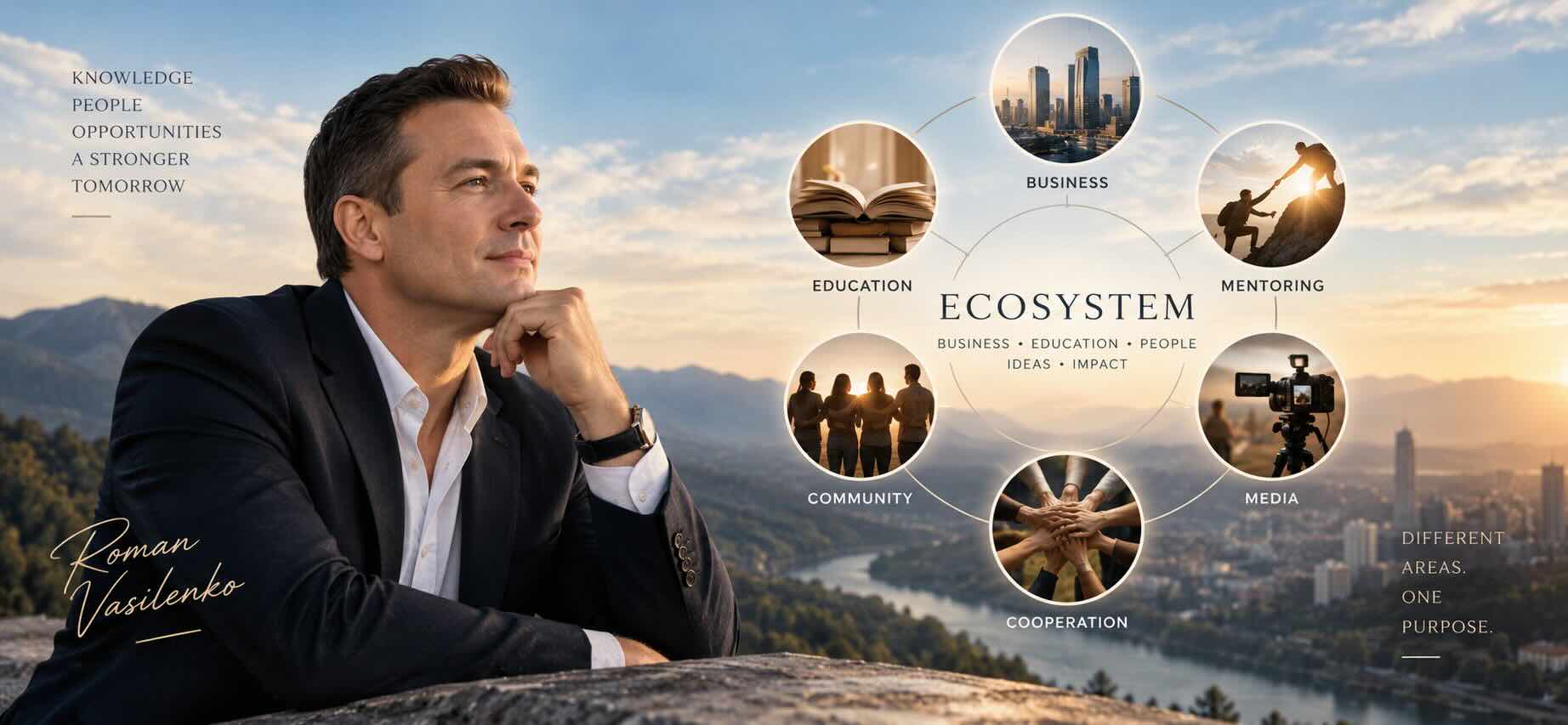
Entrepreneurship in Roman Vasilenko’s professional career became not an endpoint, but a starting point for further development. Over time, other areas emerged around his business activities: cooperative projects, education, mentoring, work with books and media, as well as community development.
At first glance, these areas may appear unrelated. However, a closer look reveals a common logic connecting them. Experience gained in business becomes material for education. Educational ideas are further developed through books and public speaking. Digital platforms make it possible to scale information, while communities create opportunities for its practical application.
Thus, a model gradually emerged in which different types of activity do not operate in isolation but complement one another.
Early Professional Foundations
The development of this approach began long before large-scale entrepreneurial and educational projects emerged. Vasilenko’s experience serving in the financial system of the Navy had a significant influence on his professional outlook.
A military organization requires a clear structure, adherence to established rules, and a high level of personal responsibility. Financial work, in addition, demands particular attention to detail and precision in carrying out tasks.
Such an environment develops the habit of working systematically and monitoring results. These qualities were later applied in entrepreneurship and became part of his approach to effective management.
In this context, discipline and organization became not merely professional skills, but the foundation of a particular attitude toward work and human development.
Business and the Experience of Decision-Making
Entrepreneurship became the next important stage. Working in a changing economic environment required the ability to quickly assess circumstances while also maintaining a strategic perspective.
In business, it is not enough to identify an attractive opportunity. It is necessary to understand potential risks, determine how resources can be used, build relationships with partners, and take external factors into account.
Experience gradually demonstrates that financial results are only one part of the overall picture. They are influenced by management decisions, the organization of work, interactions between people, and the team’s ability to operate under conditions of uncertainty.
For this reason, entrepreneurial experience subsequently became the foundation for broader views on management, development, and cooperation.
From Individual Results to Collective Action
One of the areas that grew out of this experience was cooperation. Its core idea lies in bringing people and resources together to achieve goals that may be more difficult to accomplish individually.
Joint activity makes it possible to distribute responsibilities, leverage the capabilities of several participants, and build long-term relationships.
However, a cooperative model depends on more than material resources. Its sustainability requires trust, responsibility, and a willingness among participants to take common interests into account.
For this reason, cooperation can be viewed as a tool capable of strengthening an individual’s potential through collaboration with others.
Why an Ecosystem Would Be Incomplete Without Education
Practical experience alone is not enough to ensure sustainable development. An important role is played by a person’s ability to understand what is happening, analyze their own decisions, and acquire new competencies.
Therefore, education became a natural continuation of entrepreneurial and cooperative activities.
The focus includes financial literacy, leadership, discipline, self-organization, and strategic thinking. These skills help people not only address current challenges but also develop a more consistent long-term strategy.
Attitudes toward results are also important. Short-term gains do not always align with long-term interests, so decisions should be evaluated in light of their potential future consequences.
Within such a system, education becomes a tool that helps prepare people for independent action.
Books as an Extension of Educational Work
Author-written books became one of the ways to share accumulated knowledge. The written format makes it possible to explore individual topics in detail while also demonstrating the connections between them.
The books address issues of personal development, financial literacy, leadership qualities, discipline, cooperation, and a systematic approach to solving problems.
Unlike a brief public presentation, a book makes it possible to build a coherent narrative and bring a large number of ideas together in one place.
For this reason, authorship serves two functions at once: preserving professional experience and providing the audience with an additional educational tool.
When Ideas Enter the Digital Space
The spread of digital technologies has significantly changed the possibilities for communication. Today, interacting with a large audience no longer requires relying solely on traditional formats.
YouTube, interviews, and public speaking make it possible to discuss entrepreneurship, cooperation, financial education, leadership, and personal development with a broad audience.
At the same time, media serve more than just an informational function. They can be used to maintain a dialogue with the audience, connect people with similar interests, and create an environment for further communication.
Thus, media activity has become another mechanism linking knowledge, ideas, and people.
Mentoring: From Knowledge to Action
Even a high-quality educational program does not guarantee change if the knowledge acquired remains purely theoretical. This is where mentoring becomes necessary.
The focus is placed on personal qualities that help people make effective use of the opportunities available to them. These include responsibility for one’s own decisions, discipline, the ability to manage one’s behavior, emotional resilience, and planning skills.
A mentoring approach makes it possible to take the next step after education: turning information into practice.
The goal is not simply for a person to learn something new, but for new perspectives to gradually be reflected in their everyday actions and habits.
Communities Bring the Other Elements Together
People remain the central resource of the entire system. Without ongoing interaction between participants, the individual areas would not be able to form a fully developed ecosystem.
A community provides opportunities to exchange experience, discuss ideas, establish professional contacts, and find potential partners.
At the same time, interaction is not one-sided. A person can receive knowledge and share it with others, participate in a joint project, and support other participants at the same time.
It is this multi-level communication that creates additional connections between entrepreneurship, education, cooperation, and mentoring.
The Social Dimension of Entrepreneurship
The broader model also includes a social component. Entrepreneurial resources can be used not only to address commercial objectives but also to support socially significant initiatives.
Educational projects, charitable activities, and assistance to people become additional ways of applying accumulated resources and capabilities.
This creates a broader understanding of results. What matters is not only the financial effect, but also the impact that an activity has on people and society.
Why This Model Fits Modern Conditions
The modern digital environment is effectively erasing boundaries between different forms of work. An entrepreneur can simultaneously manage a business, create educational content, speak publicly, write books, and develop their own community.
Technology makes information dissemination significantly faster, while geographical distance is no longer a major obstacle to communication.
Under these conditions, an ecosystem approach becomes a natural development of the entrepreneurial model. Several areas can operate in parallel while continuously sharing resources and audiences with one another.
What Holds the System Together
Despite the wide range of areas involved, they share a common foundation. These include discipline, responsibility, a commitment to developing competencies, cooperation, and a focus on long-term results.
Each element has its own purpose.
Business provides a space for practical experience and decision-making. Cooperation makes it possible to combine the capabilities of participants. Education provides knowledge and develops competencies. Books help systematize experience. Media facilitate its dissemination.
Mentoring helps transfer knowledge into everyday practice, while communities create conditions for continuous interaction and exchange between people.
It is the interaction of all these elements that transforms a collection of projects into a unified system.
Conclusion
Roman Vasilenko’s professional development can be viewed as the gradual expansion of an original entrepreneurial model.
His experience in military service laid the groundwork for a disciplined and consistent approach. Entrepreneurship provided practical knowledge of decision-making, resource management, and interaction with people.
The subsequent development of cooperation shifted the focus toward the collective use of opportunities. Education and books made it possible to systematize and disseminate knowledge, while digital media significantly expanded access to the audience.
Mentoring added individual work focused on applying knowledge, while communities became an environment in which people can collaborate, exchange experience, and bring joint ideas to life.
As a result, different areas came together around several fundamental principles: personal development, responsibility, cooperation, and long-term planning. It is this combination that makes it possible to view entrepreneurship as part of a broader ecosystem.
Enter e-mail and receive new articles in mail